Magnetic field :- parallel magnetic circuit

 Parallel Magnetic Circuit

Definition: A magnetic circuit having two or more than two paths for the magnetic flux is called a parallel magnetic circuit. Its behaviour can be compared to the parallel electric circuit. The parallel magnetic circuit contains different dimensional areas and materials having various numbers of paths.


The above figure shows a parallel magnetic circuit. In this circuit, a current-carrying coil is wound on the central limb AB. This coil sets up the magnetic flux φ1 in the central limb of the circuit. The flux φ1 which is in the upward direction is further divided into two paths namely ADCB and AFEB. The path ADCB carries flux φ2, and the path AFEB carries flux φ3. It is clearly seen fro the above circuit that

φ1 = φ2 + φ3

The two magnetic paths ADCB and AFEB form the parallel magnetic circuit, thus, the ampere-turns (ATs) required for this parallel circuit are equal to the ampere-turns (ATs) required for any one of the paths.

As we know, reluctance is
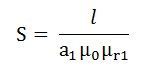
parallel-mag-ckt-eq-1
If S1 = reluctance of path BA will be
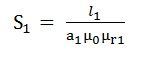
parallel-mag-ckt-eq2
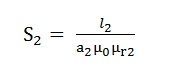
S2 =reluctance of path ADCB will be
parallel-mag-ckt-eq3
S3 = reluctance of the path AFEB will be
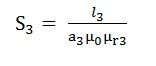
parallel-mag-ckt-eq4

Therefore, the total MMF or the total Ampere turns required in the parallel magnetic circuit will be the sum of all the individual parallel paths.

Total mmf required = mmf required for the path BA +mmf required for the path ADCB + mmf required for the path AFEB

parallel-mag-ckt-eq5

Where φ1. Φ2, φ3 is the flux and S1, S2, S3 are the reluctances of the parallel path BA, ADCB and AFEB respectively

Comments

Popular posts from this blog

What is two transistor model of scr ? Explain SCR

  Power electronics Two Transistor Model of SCR full explain and pdf. Basic operating principle of SCR, can easily be understood by the two transistor model of SCR , as it is a combination of p and n layers. This is a pnpn thyristor. If we bisect it through the dotted line then we will get two transistors i.e. one pnp transistor with J 1 and J 2 junctions and another is with J 2 and J 3 junctions as shown in figure below. The relation between the collector current and emitter current is shown below Here, I C is collector current, I E is emitter current, I CBO is forward leakage current, α is common base forward current gain and relationship between I C and I B is Where, I B is base current and β is common emitter forward current gain. Let’s for transistor T 1 this relation holds And that for transistor T 2 Now, by the analysis of two transistors model we can get anode current, From equation (i) and (ii), we get, If applied gate current is I g then cathode current will b...

Types of USB and Their Technical Specifications

Types of USB and Their Technical Specifications. USB (Universal Serial Bus) is a standard that was developed to simplify the connection between computers and peripheral devices. Over the years, several types of USB standards have emerged, each offering different capabilities. Here's a comprehensive guide to the different types of USB, including their technical specifications and comparisons. 1. USB Type-A Description : The original and most recognizable USB connector, typically used in computers, chargers, and peripherals. Specifications : Dimensions : 12.0 mm x 4.5 mm Versions : USB 1.0, USB 2.0, USB 3.0, USB 3.1, USB 3.2 Data Transfer Rates : USB 1.0: 1.5 Mbps (Low Speed) / 12 Mbps (Full Speed) USB 2.0: 480 Mbps (High Speed) USB 3.0: 5 Gbps (SuperSpeed) USB 3.1: 10 Gbps (SuperSpeed+) USB 3.2: 20 Gbps (SuperSpeed+) Power Delivery : Up to 2.5W (0.5A @ 5V) for USB 2.0, up to 4.5W (0.9A @ 5V) for USB 3.0 and above. Use Cases : Connecting keyboards, mice, flash drives, external hard d...

regula falsi, method / false position method / explain

regula falsi ,   method of false position , or   false position method   In   mathematics , the   regula falsi ,   method of false position , or   false position method   is a very old method for solving an equation with one unknown; this method, in modified form, is still in use. In simple terms, the method is the   trial and error   technique of using test ("false") values for the variable and then adjusting the test value according to the outcome. This is sometimes also referred to as "guess and check". Versions of the method predate the advent of   algebra   and the use of   equations . As an example, consider problem 26 in the  Rhind papyrus , which asks for a solution of (written in modern notation) the equation  x  +  x /4 = 15 . This is solved by false position. [1]  First, guess that  x  = 4  to obtain, on the left,  4 + 4/4 = 5 . This guess is a good choice since it pr...