Power electronics
Two Transistor Model of SCR full explain and pdf.

Basic operating principle of SCR, can easily be understood by the two transistor model of SCR, as it is a combination of p and n layers.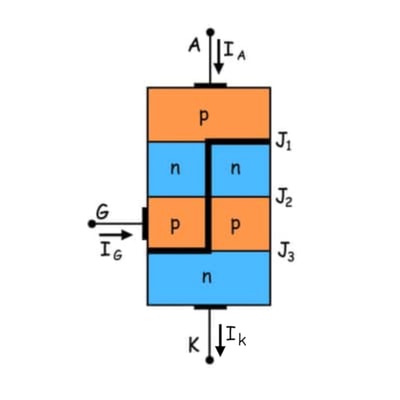
This is a pnpn thyristor. If we bisect it through the dotted line then we will get two transistors i.e. one pnp transistor with J1 and J2 junctions and another is with J2 and J3 junctions as shown in figure below.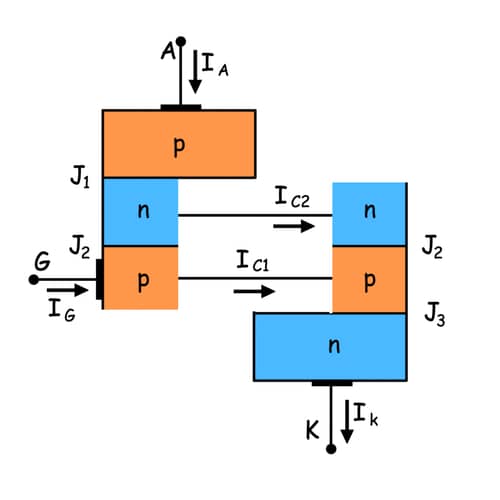
The relation between the collector current and emitter current is shown below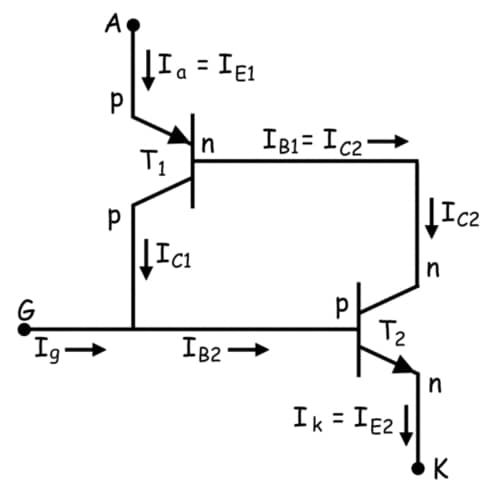
Here, IC is collector current, IE is emitter current, ICBO is forward leakage current, α is common base forward current gain and relationship between IC and IB is
Where, IB is base current and β is common emitter forward current gain.
Let’s for transistor T1 this relation holds
And that for transistor T2
Now, by the analysis of two transistors model we can get anode current,
From equation (i) and (ii), we get,
If applied gate current is Ig then cathode current will be the summation of anode current and gate current i.e.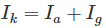
By substituting this valyue of Ik in (iii) we get,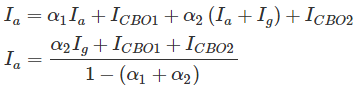
From this relation we can assure that with increasing the value of towards unity, corresponding anode current will increase. Now the question is howincreasing? Here is the explanation using two transistor model of SCR.
At the first stage when we apply a gate current Ig, it acts as base current of T2 transistor i.e. IB2 = Ig and emitter current of the T2 transistor IE2 = Ik. Hence establishment of the emitter current gives rise α2 as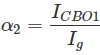
Presence of base current will generate collector current as
This IC2 is nothing but base current IB1 of transistor T1, which will cause the flow of collector current,
IC1 and IB1 lead to increase IC1 as and hence, α1 increases. Now, new base current of T2 is
 , which will lead to increase emitter current
 and as a result α2 also increases and this further increases
 .
.
As , α1 again increases. This continuous positive feedback effect increasestowards unity and anode current tends to flow at a very large value. The value current then can only be controlled by external resistance of the circuit.
FAQ
Casino games with jackpot party slot | drmcd
ReplyDeleteThis week, we will reveal 밀양 출장안마 some of the most amazing casino 영주 출장안마 games 포항 출장안마 for Canadian players. Jackpot Party 동해 출장샵 Slot. Play Now. Play Now. Win big. $2900. 오산 출장안마